Articles & techniques
The rating nut, and how not to regulate a Bulle
The knurled nut at the foot of a Bulle pendulum is its only regulator. It is also one of the most frequently damaged parts on the clocks in this gallery.
How it works
A pendulum’s period depends on its length, not its weight: for a simple pendulum it is proportional to the square root of the length.[1] Raising the bob shortens the pendulum so it swings faster and the clock gains; lowering it makes the clock lose.[1] On a Bulle, the rating nut screws up and down a split threaded rod under the coil. The split grips the nut lightly so it does not wander in use.
A correctly restored clock should run slow with the nut fully down and fast with it fully up. Several restorations are tested for a week specifically to prove that the nut alone can take the clock either way (Nº 6448, Nº 174475).
The bodge
When a clock runs slow even with the nut wound fully up, the temptation has been to take metal off the nut. Removing mass from the bottom of the pendulum raises its effective centre, so it does speed the clock up slightly. The notes for Nº 258493 describe it exactly: done “to lighten it and in effect shorten the pendulum, thereby speeding up the clock.”
It is also the wrong answer. As the notes for Nº 5909 put it: “In all my time in restoring Bulles I have never needed to adjust the weight of this nut. If the movement and pendulum are cleaned and restored correctly then the rating nut as supplied with the clock will work just fine.” And from Nº 258493: “There is never a case for doing this. If the clock is slow and cannot be speeded up by raising the nut then obviously something else is wrong.”
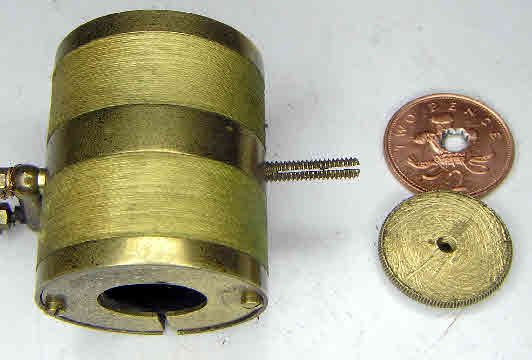
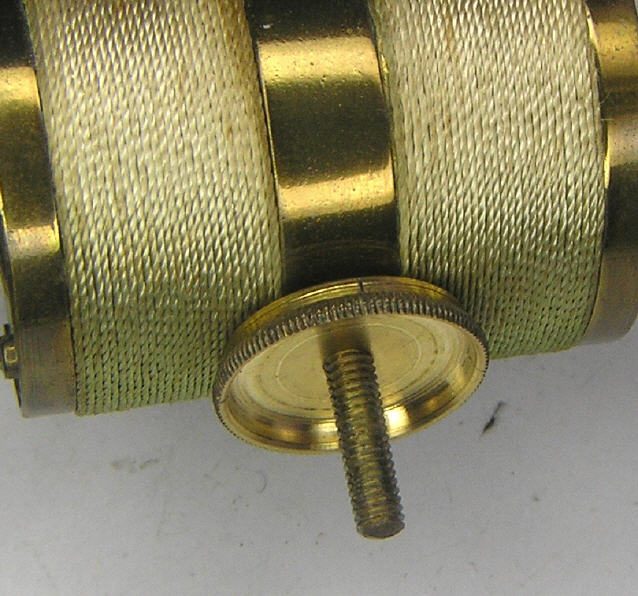
The damage takes many forms in the gallery:
- Drilled with extra holes: Nº 6448, Nº 19185, Nº 158805
- Bored or hollowed out: Nº 12199, Nº 258493
- Turned down on a lathe: Nº 7446, Nº 67438, Nº 3720
- About half the brass cut away: Nº 7495
- Cut down and then “corrected” with a two-penny piece: Nº 57561
- Replaced, with its stud snapped and glued: Nº 7221
On the small “clockette” models the problem is so widespread that the notes for Nº 158805 estimate that half of all clockette rating nuts have been drilled or cut.
The opposite bodge: added weight
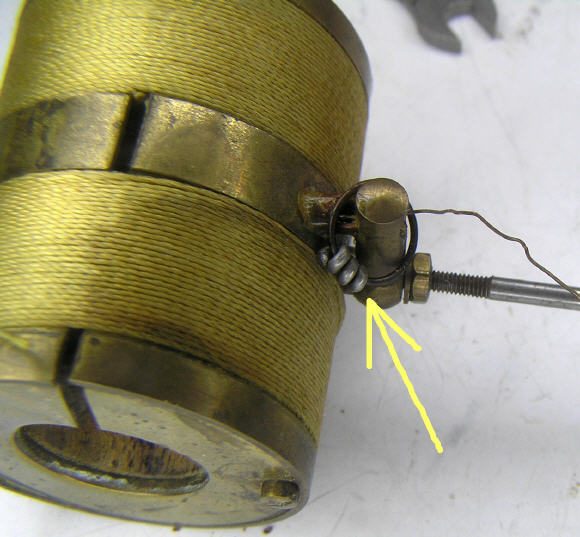
Where a clock ran fast, weight was sometimes added instead, in the hope of slowing it down. The notes for Nº 7446 compare a copper “pimple” soldered to its pendulum rod with the pennies used to regulate Big Ben. Other examples include a small brass weight on the rod of Nº 15143, two extra weights above the nut on Nº 253053, and brass scrap and part of a watch dial hidden behind the bob of Nº 313749. On Nº 95099 the “weight” was a piece of plastic, far too light to make any difference.
Eureka clocks suffer the same treatment on their balance wheels: washer weights added to slow a fast clock (Eureka Nº 9082), and balance screws undercut to lighten them (Eureka Nº 404).
Putting it right
A damaged nut is either replaced with a new one machined to the original pattern, or repaired by turning out the damage and fitting a brass insert, which can be made almost invisible (Nº 67438, Nº 3720, Nº 51540). The real cause of the poor timekeeping, usually dirt, worn contacts, a badly set contact pin or a wrongly tensioned Isochron spring, is then dealt with. See Suspension, contacts and the Isochron spring.
Sources
Workshop methods, readings and quotations are from the Horologix restoration notes linked above. Other information is from:
- Pendulum. Wikipedia. https://en.wikipedia.org/wiki/Pendulum