Articles & techniques
Suspension, contacts and the Isochron spring
A handful of small parts at the top of a Bulle decide whether it runs well: the silk suspension, the contact pin and fork, and the Isochron spring. They are also the parts most often found broken, worn or wrongly replaced.
The suspension
The Bulle pendulum hangs from a short silk suspension clamped between brass “chops”. Silk does not conduct, so a separate wire or small spring carries the current across the gap from the frame to the pendulum (Nº 20441, Nº 7421).
The silk is so often broken that the notes routinely say it is “broken as usual”. Improvised replacements found in the gallery include medal ribbon (Nº 12199), a piece of cloth (Nº 28105), red plastic pinched between the chops (Nº 186300), white insulating tape (Nº 174475) and a thin steel strip that forced the frame out of shape (Nº 313749).
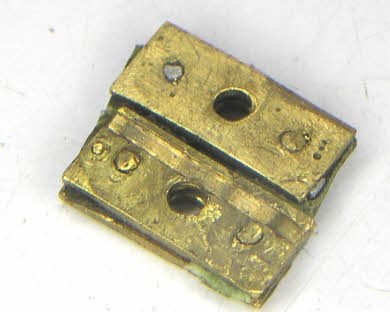
A good replacement is a new silk unit with the correct nut and bolt. The lower block needs to be free to rock backwards and forwards while the top block is held firm (Nº 266840), and the two blued steel positioning screws are often missing and have to be made.
The contact pin and fork
Each swing, the silver contact pin on the pendulum passes through the fork on the movement, making contact on one side (silver) and pushing past an insulated face on the other (fibre). This both switches the coil on and moves the count wheel on by one tooth.
The depth of the pin in the fork is critical. As the notes for Nº 6792 explain, too deep and it gathers two teeth at larger swings; too shallow and it gathers none when the swing is small. About half the pin’s diameter of engagement is the target. A clock that gains an hour or more a day is often picking up two teeth per swing because the pin is set too deep (Nº 12199).
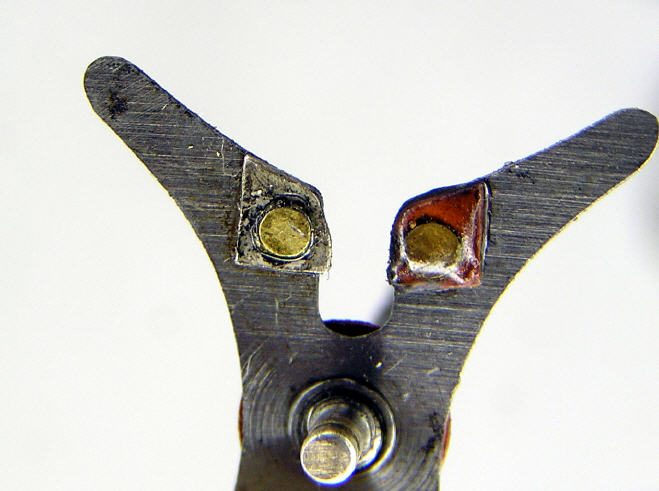
Forks wear. The silver can wear through to the steel (Nº 183374, Nº 174475), in which case new silver and fibre contacts are riveted in, or on later designs the whole fork is replaced (Nº 256525). Some forks survive remarkably well: Nº 26561’s silver fork end “will last another 80 years”. A worn contact pin can often be turned round so a fresh face meets the fork (Nº 7446, Nº 3720).
Later clocks used forks of plastic or other insulating material, which the notes for Nº 201051 see as a simplification of the early silver-and-fibre design.
The Isochron spring
The Isochron spring links the pendulum to the frame and applies a retarding force that increases with the size of the swing. Its job is to keep the clock’s rate steady as the battery voltage changes over its life.[1]
Setting it up is the last and most important step. The restoration practice described in the notes for Nº 12199 is to start with no tension at all, even at full swing, so that the rating nut’s effect can be checked first; only then is tension added. The aim, tested over a week, is a clock that runs slow with the rating nut fully down and fast with it fully up (Nº 174475).
Replacement Isochron springs of mild steel or copper wire turn up regularly (Nº 20441, Nº 130288), and the lower bracket and its “T” piece are often missing (Nº 158805). The steel T piece is remade from 0.5 mm steel. Two rare clocks, Nº 17318 and Nº 10392, have a separate Isochron adjuster that tensions the spring by a cam, one of them with a graduated dial.
The very late Nº 342201 is different again, with a pivoted suspension, a fixed brass contact pin that cannot be adjusted, and a regulating weight hidden at the back.
Sources
Workshop methods, readings and quotations are from the Horologix restoration notes linked above. Other information is from:
- Bulle clocks. NAWCC Chapter 72 (Australia) archive. https://www.aussieclocks.com.au/archive/bulle-clocks/