Articles & techniques
The striking Bulles
Most Bulle clocks are silent timekeepers. A few were made to strike the hours, using a separate motor-driven mechanism powered by the same 1.5 volt battery. Two of them have been restored here.
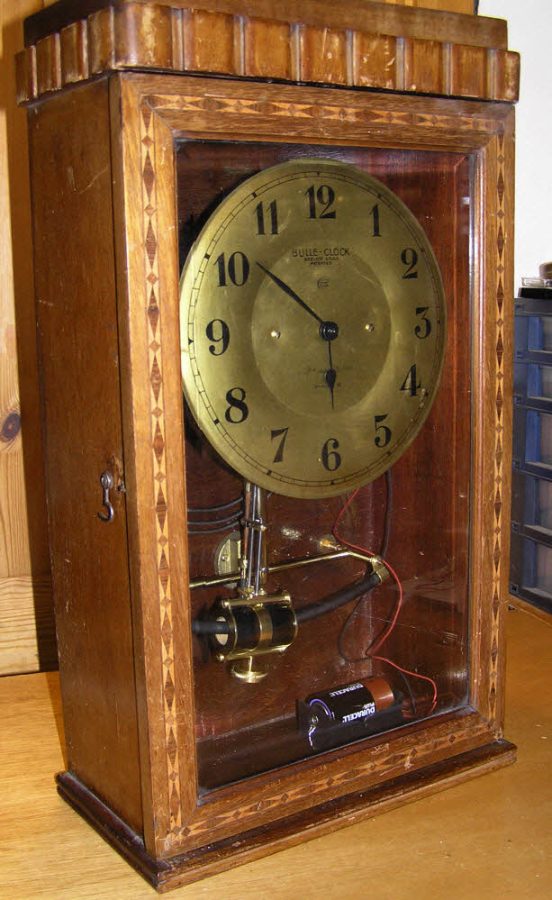
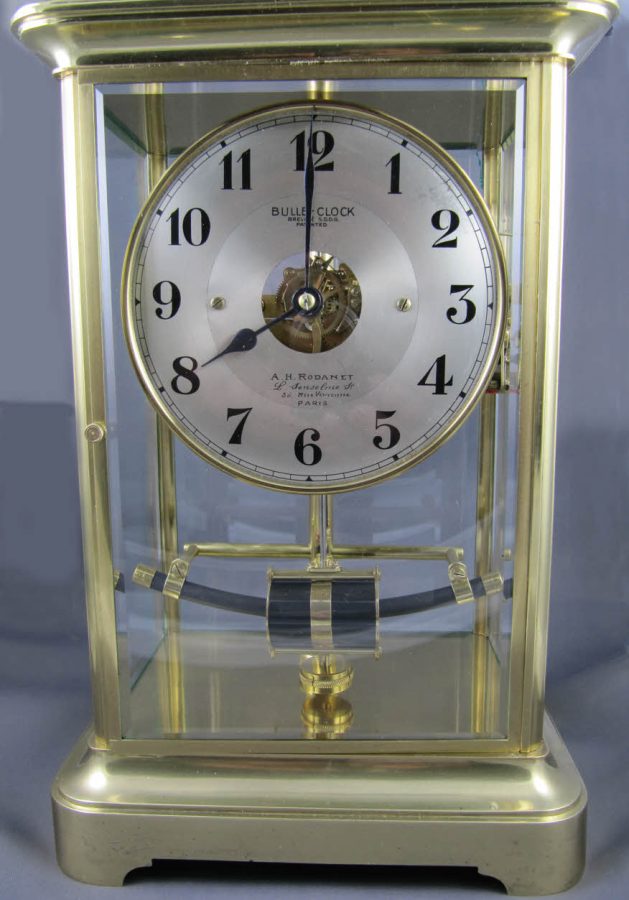
The two clocks
Nº 255595 is a striking Bulle with a half-second pendulum in a wooden case, striking on a gong with a leather-faced hammer. Its case was rebuilt to match type B9 on page 13 of the 1925 catalogue. A bell-striking version with the same mechanism was in the workshop at the same time.
Nº 190613 is a four-glass model with a ¾-length pendulum. Its striking mechanism is the same as 255595’s, but it uses a round hammer rather than the leather hammer used for a gong.
How the striking works
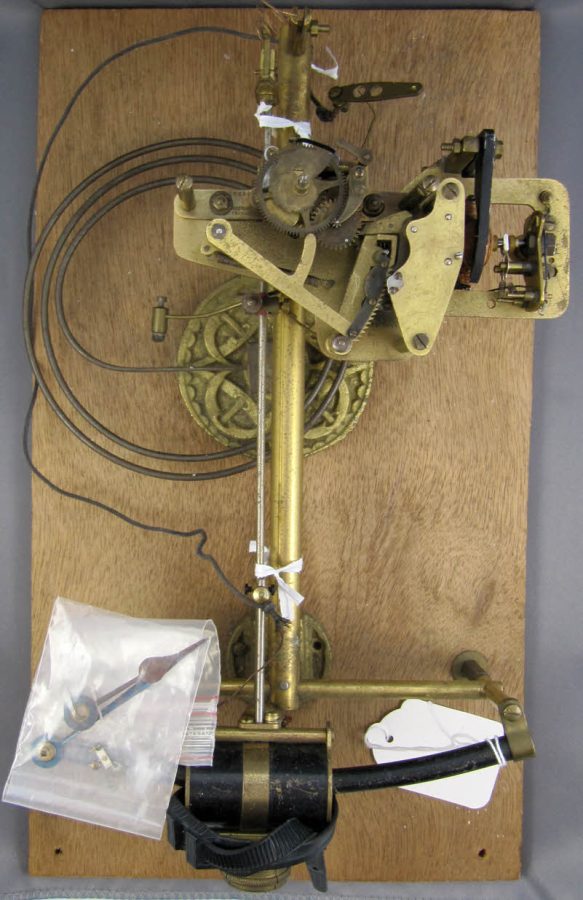
The striking is a separate, self-contained unit mounted beside the normal movement. It can be removed and tested on its own. It uses a conventional rack and snail, with the hour and minute wheels of the main movement modified to carry the lifting pins.
Surprisingly, the strike is driven by a small electric motor running from the same 1.5 volt battery as the clock. One side of the motor is wired to the negative side of the battery; the other is switched by a silver pin that touches a silver strip on the rack. While the rack is gathering, the pin rests on the strip and the motor runs; when the rack reaches the end of its travel, the contact breaks and the motor stops. On 190613 the pin is D-shaped, so that at rest it stands clear of the strip and the motor is isolated. On 255595 the motor’s three windings each measured between 10 and 15 ohms.
A shared fault
Both clocks, and at least one other striking Bulle known to the workshop, had their motor-arbour ratchet removed or disabled by a previous owner. On 190613 the notes conclude that the ratchet was in contact with the wheel at all times to stop the motor running in reverse. Why owners removed it is not clear, but it is a useful point to check on any striking Bulle.
Both clocks are flagged as striking in the Clock Gallery.
All information on this page is from the Horologix restoration notes linked above.