Articles & techniques
Dating a Bulle
Bulle clocks were made in France from 1920 until the 1950s. The serial number is the obvious starting point for dating one, but the restorations show that it is not the whole story.
The Bulle in brief
The Bulle system grew out of Marcel André-Moulin’s work on a battery clock with a three-pole magnet, which he had developed by 1912. Maurice Favre-Bulle took out the patent in 1920, and production began that year, continuing until Favre-Bulle’s death in 1954.[1]
Serial numbers and movement types
Serial numbers give a broad guide. The Early Bulle Movements document groups the movements like this:
| Movement | Proposed serial range |
|---|---|
| Half plate (plate and box tube) | pre-production to 2,000 |
| Full plate (plate and box tube) | 2,001 to 15,000 |
| Two plate | 15,001 to 255,000 |
| Three plate | 255,001 to 310,000 |
| Two plate (later production) | 310,001 onwards |
You can browse the clocks by movement in the Clock Gallery. As a rough guide from the restorations, clocks under about 7,000 date from the first year of production, about 1920–21 (Nº 3453, Nº 3720, Nº 6792); two-plate clocks in the 50,000s–60,000s are from about 1925–26 (Nº 51029, Nº 67438); the 200,000s are around 1929–30 (Nº 201051, Nº 203401, Nº 252502); and Nº 342201 is probably from the 1940s.
Why the number is not enough
Construction details do not always match the serial. Nº 12199 and Nº 12019 both have early full-plate features without the damper, and even within the full-plate group, earlier and later examples differ in details of the fork arbour and damper (Nº 7495). Movements have also been moved between bases: witness marks on Nº 284494, Nº 284391 and Nº 313749 show that a movement was not always “born” on the base it now sits on.
Always check the full number. It can be partly hidden under a fibre washer (Nº 1583) or an insulating ring (Nº 7495).
Features of the earliest clocks
The pre-production clocks, such as the earliest no-serial clock and the no-serial wall clock, have “Bulle” where the serial number would be, a half-plate movement with box tube, a damper arm on a separate plate, and no end-shake stop on the count wheel. Early production clocks had low-resistance coils of about 650–700 ohms with a separate resistor on the frame (see The Bulle coil), and sometimes card dial inserts.
Clues on the case
Presentation plaques give a date that the clock must predate: “To Miss Gebbie on the occasion of her marriage 16.6.23” (Nº 6448), “From a Horse Lover to a Horse Lover, 1928” (Nº 186300), and a 1924 presentation on Nº 5407. Nº 5962 carries a signature and the date 13 March 1923 under its case, although this does not fit neatly with its serial, suggesting stock could wait some time before sale.
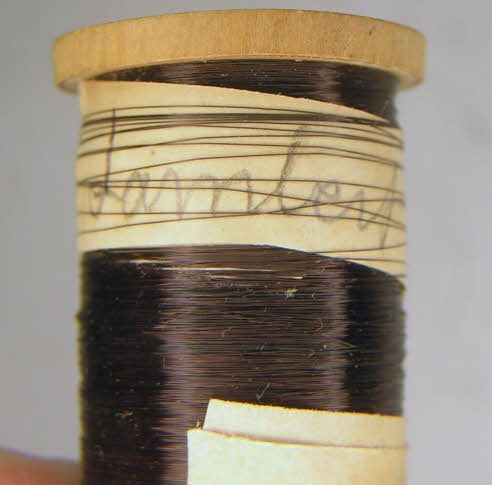
Other clues are personal: coil winders sometimes signed the paper wrapping of the coil (Nº 24834, Nº 1491), and a scrap of wartime newspaper mentioning Dunkirk found inside the coil of Nº 7495 dates a later repair rather than the clock itself.
The original sales literature on this site, from 1923 to 1948, is also useful for matching cases and models. The striking clock Nº 255595, for example, matches type B9 in the 1925 catalogue.
Sources
Workshop methods, readings and quotations are from the Horologix restoration notes linked above. Other information is from:
- Bulle clocks. NAWCC Chapter 72 (Australia) archive. https://www.aussieclocks.com.au/archive/bulle-clocks/