Articles & techniques
Common bodges, and what they do
Almost every clock in the gallery has been “repaired” at some point. Many of those repairs cause more trouble than the fault they were meant to fix. These are the ones that turn up again and again.
Solder where a part should be screwed or sprung
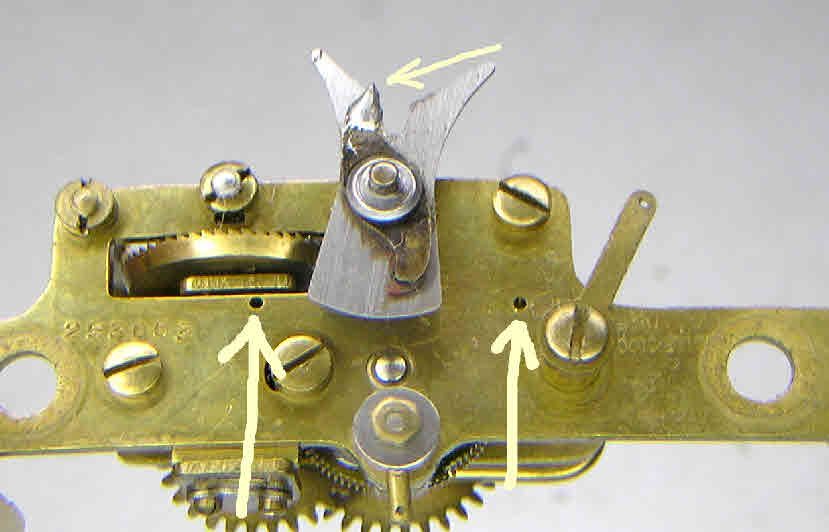
The Bulle is designed so that its wearing parts can be adjusted or replaced. The silver contact pin screws into its holder so it can be set to the right depth in the fork, and the silver contact spring is held simply under tension. Soldering these parts in place makes a simple adjustment impossible and often damages the housing.
- Contact pin soldered in: Nº 2022, Nº 57561, Nº 158805, Nº 193505, Nº 7894
- Pin replaced by a screw: a steel screw soldered into the housing on Nº 256525, and a brass screw on Nº 313749 (“They could have at least trimmed the head off”)
- Solder built up on worn contacts: Nº 253053, Nº 274481
- Contact spring soldered to its arm: Nº 258493
- Battery lead soldered to the column instead of bolted: Nº 51029, Nº 201051, Nº 313749
Brasso
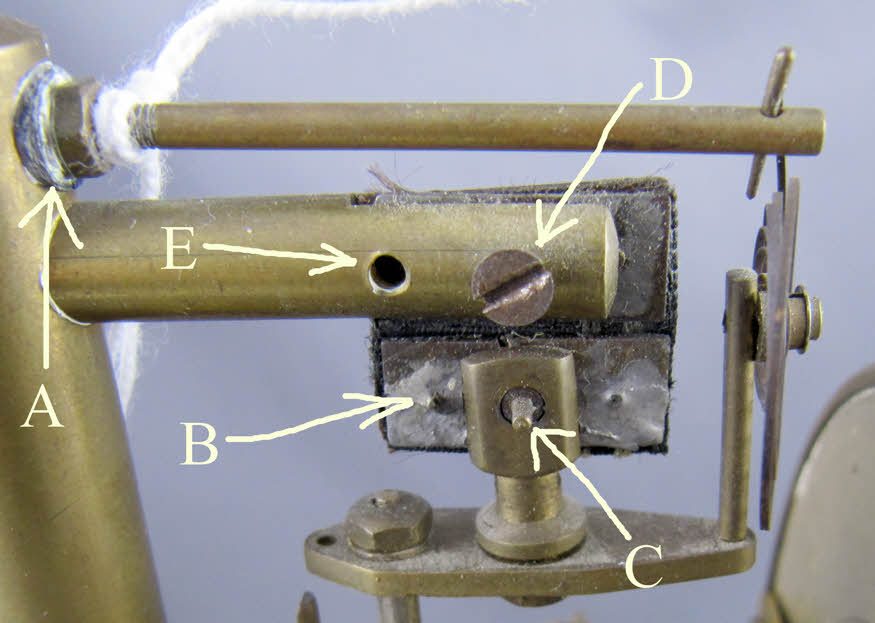
A white powder in the crevices of a Bulle is a sign of over-enthusiastic polishing. It appears on Nº 26443, Nº 193505, Nº 251321 and Nº 256525, and on Nº 1583 years of a Brasso-like cleaner had eaten into the coil cord.
Brasso contains fine abrasives and ammonia[1], and the National Trust warns that it wears metal away over time.[1] Ammonia is also the chemical behind “season cracking”, in which stressed brass develops deep, brittle cracks.[2] The Horologix rule is never to use Brasso on an assembled clock, only on individual stripped parts, and always to clean it off afterwards with methylated spirit.
Glue, epoxy and tape
Glue turns up everywhere: collars glued to magnet supports (Nº 2022, Nº 284391), a snapped rating-nut stud glued back (Nº 7221), a bobbin glued on (Nº 265502), superglue on the case back (Nº 7894) and on the coil casing (Nº 12019), and epoxy “supplementing” a Bakelite fork (Nº 183374). Modern PVC and masking tape wrapped round coils (Nº 7446, Nº 313749) can damage the fine winding when it has to be removed.
Force
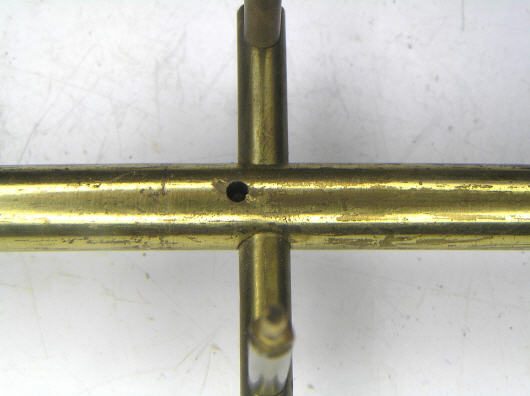
Other repairs show a lack of patience: magnet pillars levered out with a screwdriver, gouging the base (Nº 6792); a battery tube forced up through the base (Nº 28105); a centre arbour drilled and pinned, the cannon pinion soldered on and a wheel hammered off centre (Nº 3567); a wrong suspension forcing the frame to be squeezed out of shape (Nº 313749, Nº 284494). The fork arbour of a Bulle is hardened steel, and the notes repeatedly warn that it “will snap easily” if parts are forced off it.
Wrong wiring
Some bodges stop the clock outright. On Nº 253053 the rod that returns current from the coil had been connected to the pendulum rod that carries it down, “completely shorting out the system”. On Bulle 3824, used in section 4 of the restoration guide, the Isochron spring had been connected to the contact pin by someone who “did not understand the Bulle fork and contact pin mechanism”. Batteries of 3 to 9 volts have also been found in clocks designed for 1.5.
A note on restraint
Not every oddity should be “corrected”. Where a clock appears to have been assembled from more than one original, the notes for Nº 201051 point out that rebuilding it into a false originality “could be construed as misleading”. It is better to leave honest evidence of a clock’s history than to invent a new one.
Sources
Workshop methods, readings and quotations are from the Horologix restoration notes linked above. Other information is from:
- Brasso. Wikipedia. https://en.wikipedia.org/wiki/Brasso
- Season cracking. Wikipedia. https://en.wikipedia.org/wiki/Season_cracking