Articles & techniques
Battery acid damage, and how it is treated
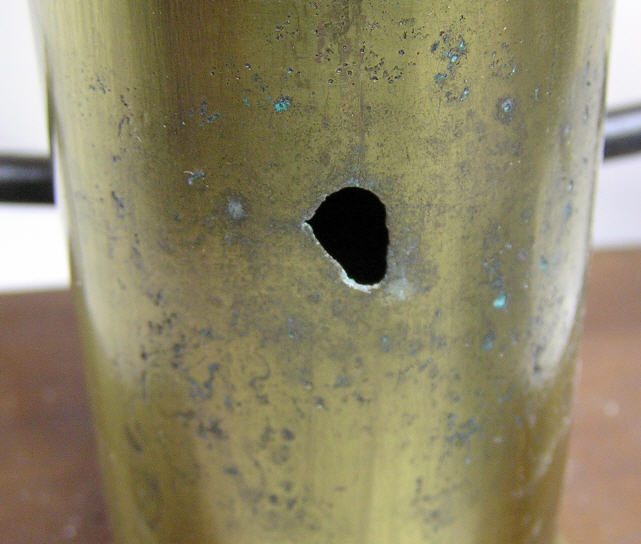
A Bulle keeps its battery inside the brass column, and a cell left to leak there for years can eat through the brass from the inside. It is one of the most common kinds of damage in the gallery.
Where the damage comes from
On a Bulle the column is more than a support: it holds the battery and forms part of the circuit. Batteries left in unused clocks for years have leaked and corroded the tube and its steel retainer from the inside.
The dry cells of the period were zinc-carbon (Leclanché) cells. Their electrolyte is an acidic paste of ammonium chloride, and as the zinc case is consumed, zinc chloride leaks out, even from cells that are not in use.[1] Modern alkaline cells leak potassium hydroxide instead, a caustic alkali.[2] Either way, the result is a corrosive deposit sitting against thin brass for years.
What it looks like
- Light burns and stains that polish out, leaving faint marks: Nº 65897, Nº 26443, Nº 5407.
- Pinholes reaching the outside: Nº 3567, Nº 11536, Nº 24834.
- Holes right through the column: Nº 7894, Nº 2022. On Nº 67438 the tube was so far gone that it was replaced.
- A coppery colour where zinc has been lost from the brass (Nº 26561). This is consistent with dezincification, in which zinc is leached from brass to leave a weak, reddish, copper-rich sponge.[3]
Not all pitting is acid. On Nº 3720 pitting along the soldered seam at the back was traced to brazing flux left on by the original maker, not to battery leakage.
The cleaning sequence
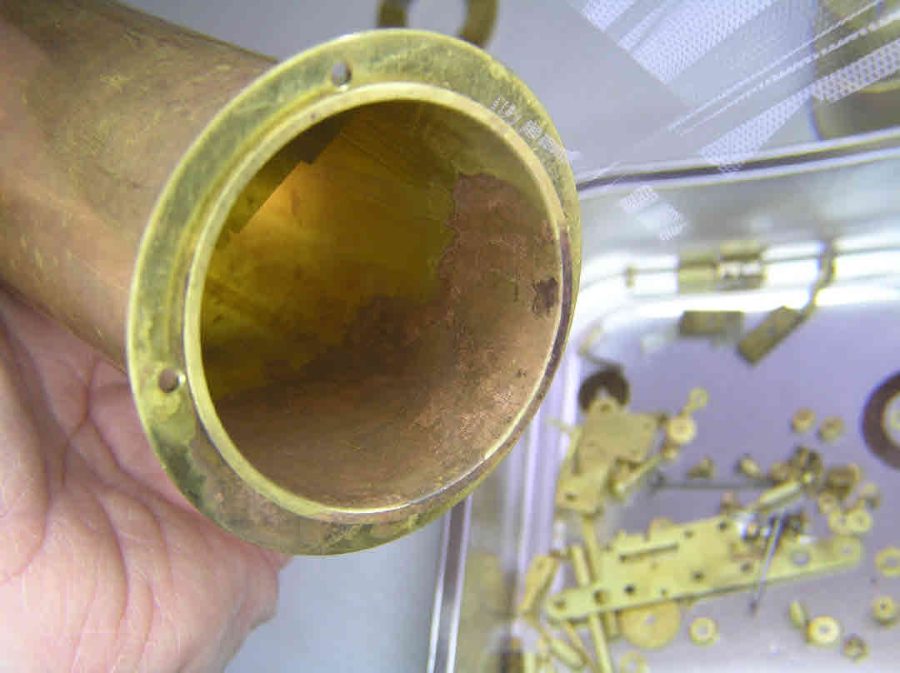
The same three-stage treatment is described across many restorations, and most fully in section 4 of the restoration guide and the notes for Nº 201051:
- Horolene, an ammoniated water-based clock cleaner, for about 30 minutes, sometimes in an ultrasonic tank, to lift dirt and loose corrosion.
- White vinegar for several hours, which the guide recommends as the best way to remove the battery residue that Horolene leaves behind.
- Bicarbonate of soda solution for about an hour, to neutralise any acid that remains. A mix of about six parts water to one of bicarbonate is mentioned.
A toothbrush scrub every 20 minutes or so helps at each stage. Once all the residue is gone, the brass “will not deteriorate further” (Nº 7894). Steel battery covers and retainers that are corroded are cleaned, primed and repainted, or remade.
Columns that cannot be removed
Some columns cannot be taken out of their bases, so the inside has to be treated in place (Nº 179287, Nº 28105). A previous attempt to force one out simply dented and damaged it.
Preventing it
The simplest protection is to take the battery out of any clock that is not running, and to check it regularly in one that is. Advice for all battery-powered equipment is the same: remove batteries before storage and keep them somewhere dry.[2]
Sources
Workshop methods, readings and quotations are from the Horologix restoration notes linked above. Other information is from:
- Zinc–carbon battery. Wikipedia. https://en.wikipedia.org/wiki/Zinc%E2%80%93carbon_battery
- Alkaline battery. Wikipedia. https://en.wikipedia.org/wiki/Alkaline_battery
- Dezincification. Wikipedia. https://en.wikipedia.org/wiki/Dezincification